
Hernia Repair (of the Abdominal Wall) in Limassol, Cyprus
A common, highly treatable condition where tissue pushes through a weak spot. Dr. Koulouteris selects the appropriate technique — laparoscopic or the classic open method — according to each patient’s situation.
- Technique
- Laparoscopic or open hernia repair
- Anaesthesia
- General anaesthesia, or regional anaesthesia in selected cases
- Procedure time
- Approx. 45–90 minutes — depends on how long-standing and how large the hernia is
- Hospital stay
- Usually day-case or one overnight stay at the clinic
- Return to activity / daily routine
- Around 1–2 weeks (light activity) Around 4 weeks (full activity)
- Private or through GESY
- These operations are covered both within GESY and privately and/or through insurance funds.
What is a hernia?

A hernia occurs when an internal organ — most often a section of bowel or fatty tissue — pushes through a weakness in the muscle or connective tissue of the abdominal wall. The result is usually a visible, palpable bulge that may appear or enlarge when you stand, cough or lift.
The most common types are inguinal (in the lower part of the abdominal wall), umbilical (around the navel) and incisional (at the site of a previous operation). Once a hernia is present it tends to grow, and surgical repair is the only definitive treatment — modern techniques make it a safe, routine procedure.
Types of hernia
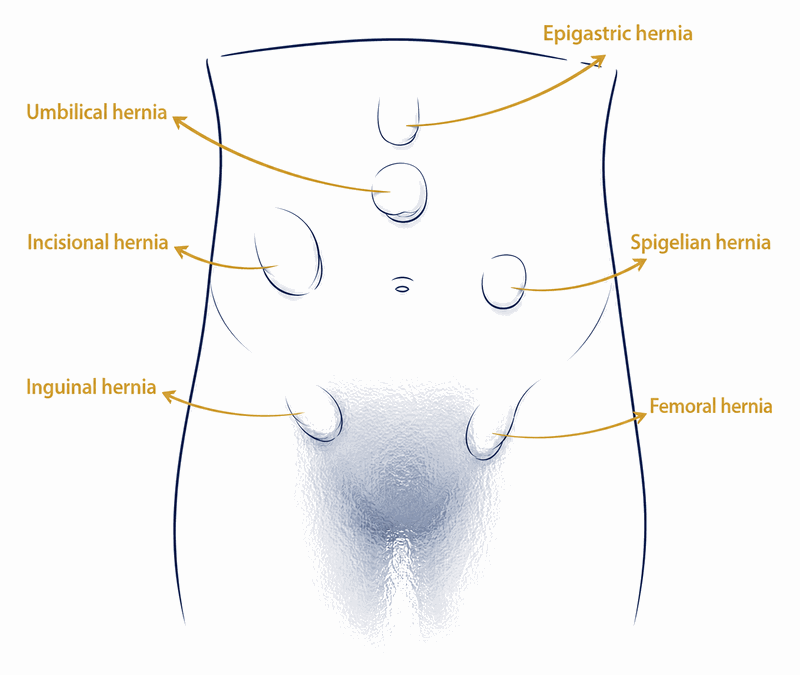
Hernias are named according to where they occur in the abdominal wall. The most common are described below — Dr. Koulouteris treats all of them, choosing the technique best suited to the type, size and location.
- Inguinal hernia — The most common type, occurring in the groin. More frequent in men.
- Femoral hernia — Lower in the groin, near the top of the thigh. More common in women and more prone to becoming trapped.
- Umbilical hernia — Occurs at or near the navel.
- Epigastric hernia — Develops in the midline of the abdomen, between the navel and the breastbone.
- Incisional hernia — Appears at or near the scar of a previous abdominal operation.
- Spigelian hernia — A rarer hernia that develops along the side of the abdominal wall.
Signs & symptoms of a hernia
Many people live with a hernia for months before seeking advice. If you recognise any of the following, it is worth arranging an assessment:
- A bulge or lump in the groin, abdomen or near the navel
- A swelling that appears when standing, coughing or straining and may disappear when lying down
- A dragging, aching or heavy sensation in the area
- Discomfort or pain when lifting, bending or exercising
- A burning or pinching feeling at the site of the bulge
- In incisional hernias — a bulge developing at or near an old surgical scar
When to seek urgent care
If a hernia becomes suddenly painful, hard, tender or discoloured, or is accompanied by nausea, vomiting or an inability to pass stool, seek medical attention immediately — this may indicate a trapped (incarcerated or strangulated) hernia, which is an emergency.
How hernia repair is performed
Dr. Koulouteris selects the most appropriate technique for each patient based on the type, size and location of the hernia, as well as your general health and lifestyle. Both approaches reinforce the weakened area, in most cases with a soft surgical mesh.
- 01
Consultation & assessment
A clinical examination and, where needed, an ultrasound or other imaging confirms the diagnosis. The technique, anaesthesia and any preparation are discussed and agreed with you.
- 02
Anaesthesia
The operation is usually carried out under general anaesthesia. In selected cases, regional or local anaesthesia may be indicated.
- 03
The repair
In a laparoscopic repair, small incisions (5–10 mm) are made through which a camera and fine instruments are placed to carry out the procedure. In an open repair, a single incision is made directly over the hernia.
- 04
Recovery room
After the operation the patient is monitored in the recovery room until they are safely transferred to the ward.
What to know before your surgery
- 01You may be asked to stop eating and drinking for several hours before the operation.
- 02Tell the Doctor about all medication you take — some blood-thinning medicines may need to be paused.
- 03Arrange for someone to drive you home and, ideally, to stay with you for the first 24 hours.
- 04Stopping smoking and losing weight for a period before the operation supports better healing and lowers the risk of complications.
What recovery looks like
Most patients recover from hernia repair quickly and comfortably. The timeline below is a general guide — your exact recovery depends on the technique used and your individual healing.
Day 1–2
Some soreness, swelling or bruising around the wound, or in the scrotum in the case of an inguinal hernia, is normal and managed with simple pain relief. Short, gentle walks are encouraged from the first day.
Week 1
Most everyday activities and desk-based work can usually be resumed. Avoid heavy lifting and strenuous effort.
Weeks 2–4
Light exercise is gradually reintroduced. A follow-up appointment confirms the wound is healing well.
Beyond 4–6 weeks
Most patients return to full activity, including heavier lifting and sport, once cleared by the Doctor.
Contact the clinic if you notice
- •Increasing pain, redness or swelling around the wound
- •Fever, or discharge from the incision
- •A returning bulge at the repair site
- •Persistent nausea, vomiting or difficulty passing stool
Frequently asked questions
The operation itself is carried out under anaesthesia, so you feel nothing during it. Afterwards, mild to moderate soreness is normal for a few days and is well controlled with simple pain relief.
Discuss your hernia with Dr. Koulouteris
Every hernia is different. Book a consultation to have your case assessed in person and receive a clear, tailored treatment plan.
This information is reviewed by Dr. Eleftherios Koulouteris, General & Laparoscopic Surgeon. It is for general guidance only and does not replace a personal medical consultation.