
Laser Haemorrhoidoplasty (LHP) in Limassol, Cyprus
Haemorrhoids are swollen blood vessels in and around the back passage — common, benign and very treatable. Dr. Koulouteris treats them with LHP®, a minimally invasive laser technique that avoids cutting and offers a faster, more comfortable recovery than conventional surgery.
- Technique
- LHP® — Laser HemorrhoidoPlasty (minimally invasive)
- Anaesthesia
- General or regional anaesthesia, with sedation in some cases
- Procedure time
- Approx. 15–20 minutes
- Hospital stay
- Day-case — usually home the same day
- Return to routine
- Often within a few days
- Private or through GESY
- These operations are covered both within GESY and privately and/or through insurance funds.
What are haemorrhoids?
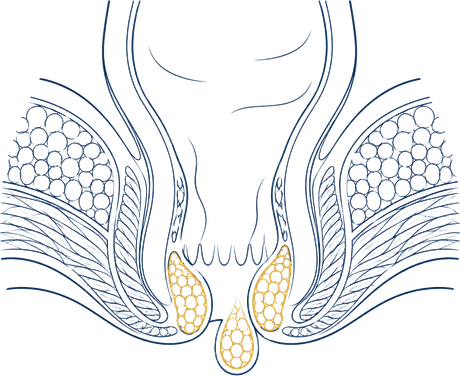
Haemorrhoids are swollen blood vessels inside or around the anus and lower rectum. Normally they act like a cushion that helps the anus close smoothly; over time they enlarge and, depending on the stage, prolapse out of the anus.
Haemorrhoidal disease is very common: it affects more than 50% of both sexes over the age of 50, and around 80% of people will experience it at least once at some point in their lives.
The main predisposing factors are gastrointestinal disorders, a sedentary lifestyle, heavy work, age, pregnancy, obesity, chronic cough and spending long periods on the toilet. The right treatment depends on the grade: mild cases may settle with lifestyle measures, while persistent, bleeding or prolapsing haemorrhoids usually need a procedure. Laser treatment (LHP®) offers a modern, tissue-sparing alternative to conventional surgical removal.
Stages of haemorrhoidal disease
Haemorrhoidal disease is classified into four grades. The grade guides the most appropriate treatment.
- 1st degree (stage I) — No prolapse. Only protruding blood vessels.
- 2nd degree (stage II) — Prolapse, but with immediate (spontaneous) reduction.
- 3rd degree (stage III) — Prolapse that requires manual reduction with a finger.
- 4th degree (stage IV) — Prolapse that cannot be reduced.
Signs & symptoms of haemorrhoids
Haemorrhoid symptoms are common and easily assessed. If any of the following are affecting you, an evaluation is worthwhile:
- Bright red bleeding during or after a bowel movement
- Itching, irritation or a burning feeling around the anus
- A soft lump or swelling at or near the back passage
- A feeling of fullness or incomplete emptying after going to the toilet
- Discomfort, aching or pain when sitting
- Mucus discharge or difficulty keeping the area clean
Always have rectal bleeding checked
While haemorrhoids are the most common cause of rectal bleeding, bleeding should never be assumed to be harmless. Any rectal bleeding — particularly a change in bowel habit, dark blood, or bleeding with weight loss — should be assessed by a doctor to exclude other conditions.
How laser haemorrhoid treatment works
LHP® is a modern method for treating 2nd-to-4th-degree haemorrhoidal disease. It treats the haemorrhoids from within using controlled laser energy, with no cutting or removal of tissue. It is a painless and relatively bloodless method, with no injury to the mucosa or the anal sphincters, a short stay at the clinic and an almost immediate return to work and daily activities, and a high success rate (around 98%).
- 01
Consultation & assessment
A clinical examination — including a digital rectal examination and proctoscopy — confirms the diagnosis and the grade; a sigmoidoscopy or colonoscopy may be advised to exclude other causes, especially when there is bleeding. The technique, anaesthesia and any preparation are then discussed and agreed with you.
- 02
Anaesthesia
The treatment is carried out under general or regional anaesthesia, with sedation used in some cases.
- 03
Laser treatment
During the procedure a small incision (about 2–3 mm) is made in the skin at the anal opening, through which a laser catheter is introduced. The catheter is placed at the centre of each haemorrhoid and shrinks it individually beneath the mucosa, leaving only a very small wound at each incision.
- 04
Recovery room
You are monitored briefly in the recovery area and, in most cases, return home the same day.
What to know before your treatment
- 01You may be given simple bowel-preparation instructions to follow before the procedure.
- 02Tell the Doctor about all medication you take — some blood-thinning medicines may need to be paused.
- 03Arrange for someone to drive you home, particularly if sedation or general anaesthesia is used.
- 04A high-fibre diet and good hydration before and after treatment support a smoother recovery.
What recovery looks like
The procedure has an immediate effect of about 40%, with the full 100% achieved over roughly 6 weeks — without the patient feeling or noticing anything in their daily activities. The timeline below is a general guide; your individual recovery depends on the size and number of haemorrhoids treated.
Day 1–2
Mild discomfort, a feeling of fullness or minor spotting can occur and are managed with simple pain relief. Gentle movement is encouraged.
Week 1
Most people return to everyday activities and desk-based work. Avoid heavy lifting and prolonged sitting.
Weeks 2–3
Symptoms continue to settle. A follow-up appointment confirms healing is progressing well.
Beyond 3 weeks
Most patients are back to their full routine. A high-fibre diet helps protect the long-term result.
Contact the clinic if you notice
- •Heavy or persistent bleeding
- •Fever, or pain that increases rather than improves
- •Difficulty passing urine
- •Significant swelling or signs of infection
Frequently asked questions
The treatment is carried out under anaesthesia, so you feel nothing during it. Because LHP® involves no cutting, most patients have noticeably less discomfort afterwards than with conventional surgery, managed with simple pain relief.
Discuss haemorrhoid treatment with Dr. Koulouteris
You do not have to live with the discomfort of haemorrhoids. Book a consultation for a discreet, professional assessment and a treatment plan suited to you.
This information is reviewed by Dr. Eleftherios Koulouteris, General & Laparoscopic Surgeon. It is for general guidance only and does not replace a personal medical consultation.