
PEG Feeding Tube Placement in Limassol, Cyprus
A PEG (percutaneous endoscopic gastrostomy) is a feeding tube placed directly into the stomach to provide nutrition, fluids and medication when eating by mouth is no longer safe or sufficient. Dr. Koulouteris places PEG tubes using a gentle, minimally invasive endoscopic technique.
- Technique
- Percutaneous endoscopic gastrostomy (PEG) — guided by endoscopy
- Anaesthesia
- Local anaesthesia with sedation
- Procedure time
- Approx. 20–30 minutes
- Hospital stay
- Short stay or day-case, depending on circumstances
- Feeding starts
- Usually within about a day of placement
- Private or through GESY
- These operations are covered both within GESY and privately and/or through insurance funds.
What is a PEG feeding tube?
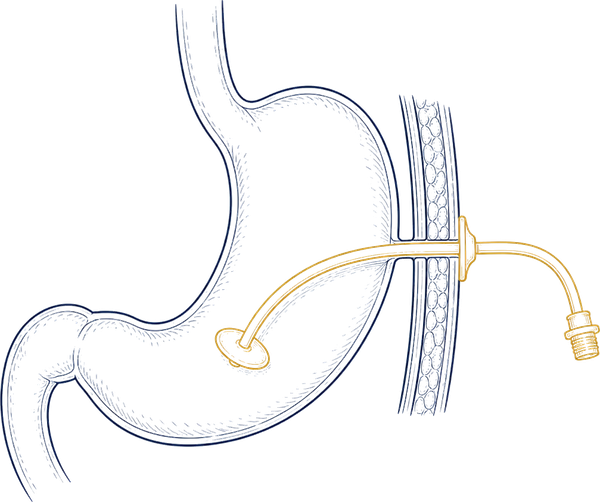
A PEG — percutaneous endoscopic gastrostomy — is a soft, thin feeding tube that passes through the wall of the abdomen directly into the stomach. It allows nutrition, fluids and medication to be given reliably when a person cannot swallow safely, or cannot take enough by mouth to stay well nourished.
A PEG is placed with the help of an endoscope — a thin, flexible camera passed into the stomach — which means no large incision and a quicker, gentler procedure than open surgery. A PEG can be used for as long as it is needed and removed later if a person's ability to eat recovers. For many patients and families it makes day-to-day care simpler and supports better strength and comfort.
When a PEG tube may be recommended
A PEG is considered after a careful assessment, usually for one of the following reasons. The Doctor will explain whether it is the right step in your or your relative's situation:
- Difficulty or unsafe swallowing (dysphagia), often after a stroke or with a neurological condition
- Being unable to take enough food or fluid by mouth to maintain weight and strength
- Recurrent chest infections caused by food or drink entering the airway
- Head and neck conditions that make eating by mouth difficult
- A need for reliable nutrition support over the longer term
- Difficulty taking essential medication by mouth
When to seek prompt care
Unintended weight loss, repeated choking or coughing during meals, or recurrent chest infections should be assessed without delay. Early discussion allows nutrition to be supported before a person becomes weak or unwell, when any procedure is better tolerated.
How a PEG tube is placed
PEG placement is a well-established, minimally invasive procedure. The steps below give a general outline — the Doctor will explain each stage for your specific situation.
- 01
Consultation & assessment
Swallowing, nutrition and overall health are assessed to confirm a PEG is suitable. The procedure, care and what to expect are discussed with the patient and family.
- 02
Sedation & preparation
The procedure is carried out under local anaesthesia with sedation, so it is comfortable. A period of fasting beforehand is needed.
- 03
Endoscopic placement
An endoscope is passed into the stomach (as in a gastroscopy) to guide the procedure. A small opening is made in the abdominal wall and the feeding tube is placed and secured.
- 04
Recovery & starting feeds
The patient is monitored after the procedure, and feeding through the tube usually begins within about a day, following the team's guidance.
What to know before the procedure
- 01Tell the Doctor about all medication — some, particularly blood-thinning medicines, may need to be adjusted or paused.
- 02Fasting instructions are given for the hours before the procedure.
- 03A family member or carer is welcome to take part during feeding, as this is often part of ongoing tube care.
- 04The team will explain day-to-day tube care and feeding before the patient goes home.
What recovery looks like
Most people settle quickly after PEG placement. The timeline below is a general guide — the team will give advice specific to the patient.
Day 1–2
Some tenderness around the tube site is normal and managed with simple pain relief. Feeding through the tube is started gradually under guidance.
Week 1–2
The tube site heals. The patient and carers become confident with daily tube care, feeding and keeping the area clean.
Ongoing
Once healed, the PEG becomes a simple, routine part of daily care. Feeds and medication are given through the tube as advised.
Longer term
A PEG can stay in place for as long as it is needed, and can be replaced or removed if circumstances change. Any review is planned with you.
Contact the clinic if you notice
- •Increasing pain, redness, swelling or discharge around the tube site
- •Fever or generally feeling unwell
- •The tube becoming blocked, leaking or coming out
- •Vomiting, or pain when feeds are given
Frequently asked questions
The procedure is carried out under local anaesthesia with sedation, so it is comfortable. Afterwards there may be some tenderness around the tube site for a few days, which is easily managed with simple pain relief.
Discuss a PEG feeding tube with Dr. Koulouteris
If eating by mouth is no longer safe or enough, a PEG can support reliable nutrition and simpler care. Book a consultation to discuss whether it is the right step.
This information is reviewed by Dr. Eleftherios Koulouteris, General & Laparoscopic Surgeon. It is for general guidance only and does not replace a personal medical consultation.